Tier 3 · Clinical reasoning engines

PsychAssist.ai: what it is, and who it is for
the whole case in one place, where the report is an outcome of the workflow rather than a separate writing job, and every claim in it can be opened back to its source.
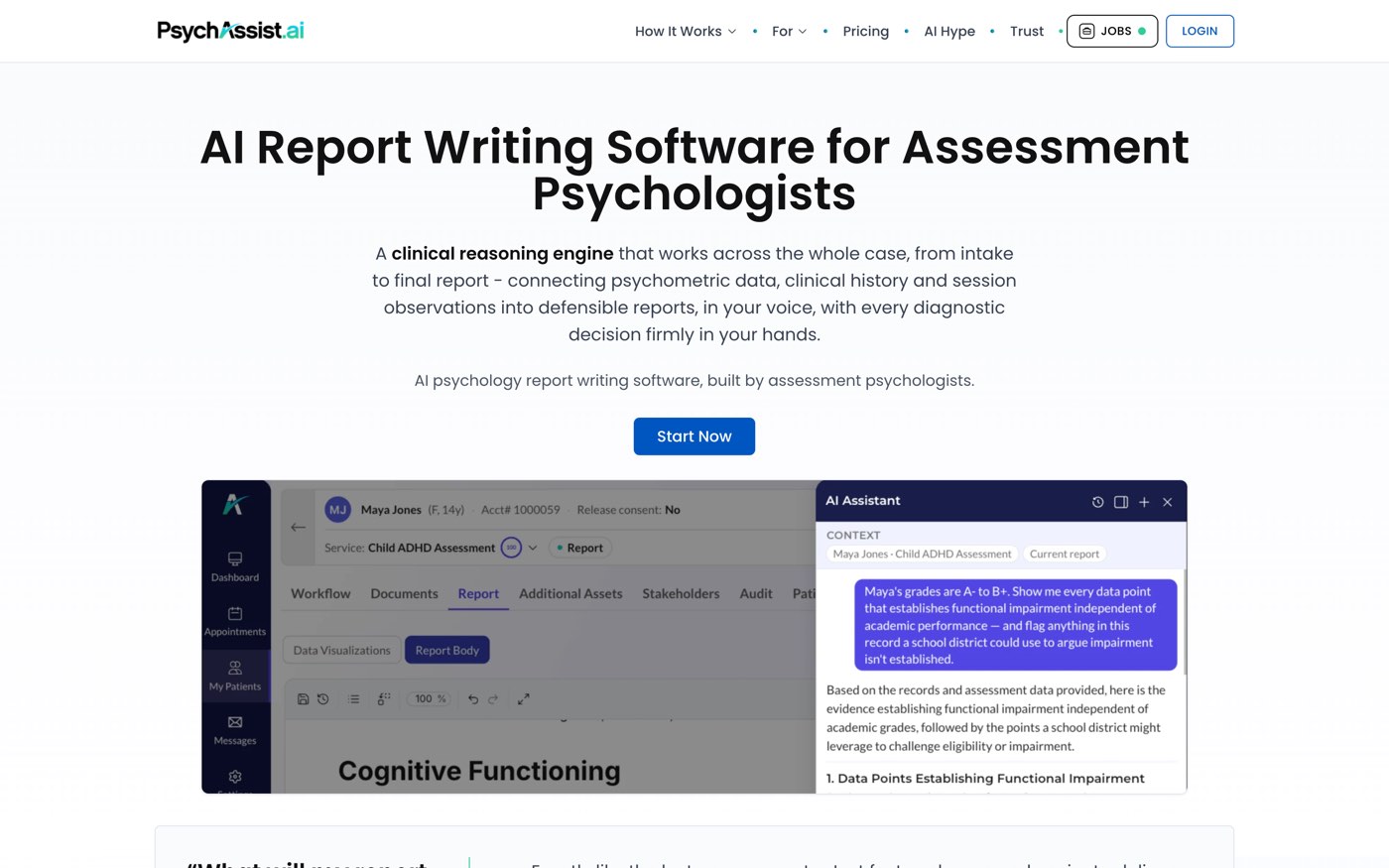
What it is
An end-to-end platform for assessment psychology, from intake through the signed report and the documents that follow it. A clinical reasoning engine holds the structured case file, reasons across the full battery at once, surfaces evidence that diverges from the formulation, and ties every claim to the measure, document or session note behind it.
Who it is for: Assessment psychologists, neuropsychologists, school psychologists and group practices running full batteries.
Scope of the work it takes on: Full assessment workflow: intake, structured data capture, generation, case chat, and the derived documents a report owes afterwards.
Which of the three kinds it is
Tier 3 · Clinical reasoning engines
Works on the case, not the document. Structured, clinician-approved data; reasoning that runs across the whole battery at once; divergence surfaced and every claim tied to its source.
You carry: the judgement. Which was the only part that was ever yours.
The tiers come from the three kinds of AI in psychological assessment report writing. They are about what a system does when the data contradicts itself, not about quality or price.
What it does well
- Reasons across the entire battery at once rather than section by section
- Surfaces divergent evidence against a rendered diagnosis without being asked
- Every claim opens back to the measure, document or session note it came from
- Nothing enters the case file without an explicit, logged clinician approval
- Learns the clinician's own voice from their finished reports
- Generates school letters, PCP summaries and feedback documents from the signed report
What it is not built for
- A two-minute report. Reading the full record and carrying provenance takes longer
- Instant self-serve sign-up: workflows are configured to a practice before they are useful
- General medical documentation outside assessment psychology
What its makers state
- HIPAA and BAA
- HIPAA compliant, with a business associate agreement available to every customer.
- Data handling
- Customer data is not used to train models. Data handling is set out in full on the trust page.
- Claims traceable to a source
- Every clinical claim resolves to an identifiable source, openable from the claim itself.
- Surfacing contradictory data
- Evidence that diverges from a rendered diagnosis is surfaced to the clinician without being asked for.
- Clinician approval step
- No machine-generated content enters the patient record without an explicit, logged act of clinician approval.
Common questions
- Is PsychAssist a report generator?
- No. A generator starts from the document and fills it in. PsychAssist starts from the case: structured data a clinician has approved, reasoning that runs across the whole battery, and a report derived from it at the end. The document is an outcome of the workflow rather than the product itself.
- Why is there no instant free trial?
- Because a workflow has to be configured to a practice before it produces anything worth signing: your measures, your templates, your voice, your stages. A self-serve trial would show you a generic version of a product whose whole point is that it is not generic.
Sources
Everything attributed to PsychAssist.ai on this page comes from their own published material, read on 1 October 2026. Products change; if something here is out of date, tell us at info@psychassist.ai and we will correct it.
Looking at more than one of these?
See every AI report writer for psychologists, sorted by kind →